JAMM 34- Entropy
Natures urge to find disorder.

Reader, it’s been a while coming, but here I am, manic as ever.
The silence wasn’t entirely intentional; life just decided to run a few experiments on me along the way. Some worked out beautifully, others produced results I’m still trying to understand. But the last few months have been chaotic, and that chaos led me back to a concept that has always fascinated me.
Entropy.
As an engineer and as someone who somehow finds himself surrounded by chaos more often than not, entropy is one of those ideas that quietly explains the world if you’re willing to look closely enough. In its simplest form, entropy is the tendency of any system to drift toward disorder. Order requires effort, attention, and energy. Chaos, on the other hand, needs none of that. Leave anything alone long enough, and it will eventually fall apart.
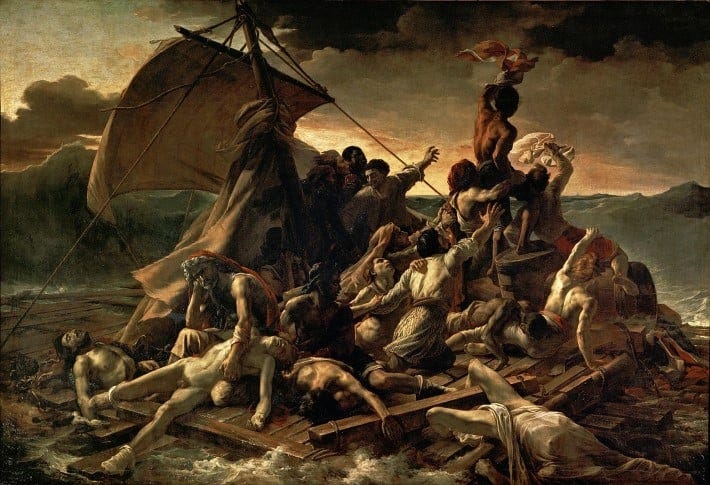
The Raft of the Medusa by Théodore Géricault
You see this everywhere if you think about it. Clean your room, and for a brief moment, everything feels aligned, like you’ve restored a tiny piece of order in the universe. Give it a week, and the chair has become a wardrobe, the desk a dumping ground, and the floor a quiet reminder of things you meant to deal with later. It’s not that you actively tried to make it messy; disorder simply crept in the way nature prefers.
Or take something as simple as a cup of hot coffee. Leave it sitting there, and slowly it loses its heat, drifting toward the temperature of the room around it. It never mysteriously becomes hotter again on its own. Nature has a direction, and that direction almost always points toward equilibrium and decay.
The longer anything exists, the more usable energy it loses.
Strangely enough, humans are no exception.
You see it around you constantly. People say they want something, but their habits and actions quietly drift in the opposite direction. A person who wants love will steer as far away from it in the hope of finding it. They speak about ambition, about purpose, about becoming something greater, but comfort has a way of pulling them back into familiar routines. Most people genuinely intend to improve themselves, yet slowly, almost invisibly, they slip back into patterns that demand less effort.
Entropy has a way of working on human lives the same way it works on physical systems.
And the truth is, chaos burns far more than we think we can handle. When you’re younger, disorder feels exciting. Late nights, reckless decisions, chasing every small pleasure that crosses your path can feel like freedom. There’s a thrill in the unpredictability, a sense that life is wide open and meant to be experienced without restraint.
But the older you get, the more clearly you begin to see the cost of that chaos. Energy becomes something you value differently. Time becomes less infinite than it once felt. The same habits that once seemed harmless slowly begin to drain you.
And at some point, the question changes.
It’s no longer how much chaos you can survive, but how much order you can maintain before chaos inevitably pushes back.
Because entropy isn’t just around us, it’s within us as well. Your body ages, your energy fluctuates, and systems that once worked effortlessly begin to require maintenance. Even the simple fact that one day we will all die is nature quietly returning us to disorder.
Yet the strange thing about understanding entropy is that it also reveals where our power lies.
You cannot eliminate entropy, but you can delay it. You can resist it long enough to build something meaningful.
Order never appears naturally; it has to be created and protected. The few things that remain within your control, your actions, your habits, and the structure of your daily life, are the small barriers that slow the drift toward disorder.
But there is another element of entropy that people rarely acknowledge.
The entropy of the people around you.
Systems influence systems. A decaying system rarely stays isolated; it pulls others toward the same direction. Place a bottle of hot water in a tub of ice, and the heat slowly escapes while the ice melts. Both systems move toward equilibrium, but the stronger force determines the outcome.
Human lives behave in much the same way. The people you surround yourself with quietly affect the order of your own system. Their habits, their energy, their outlook on life bleed into yours whether you intend it or not. Some people stabilise you, helping you preserve your energy and focus. Others accelerate the slow decay of your discipline and clarity.
And perhaps there has never been a more relevant time to understand chaos than now. The world spins faster than ever, information floods every corner of our lives, outrage travels faster than reflection, and distraction has become almost impossible to escape. Modern life constantly nudges us toward disorder while convincing us that we are still in control.
Within all of this, three elements quietly determine the structure of most lives.
Your health.
Your wealth.
Your relationships.
When these begin to decay, entropy spreads quickly. Energy fades, purpose weakens, and the structure that once held everything together slowly begins to collapse.
Which is why sometimes the only real cure for entropy is something uncomfortable but necessary.
You purge the elements that accelerate the decay.
That might mean walking away from habits that drain your energy, distancing yourself from environments that keep you stagnant, or letting go of relationships that quietly dismantle your peace. Not out of bitterness, but out of clarity.
Because entropy does not negotiate.
If life itself constantly pushes us toward the edge of non-existence, then the most deliberate act we can take is to build systems that preserve who we are. Like a thermos holding warmth inside a cold environment, or ice preserving the cool of a drink on a hot afternoon, certain structures allow us to maintain order in the middle of chaos.
The older you get, the more clearly you begin to recognise these stabilising forces. You understand your own internal storms better, and with that understanding comes the knowledge of what restores your balance. Certain people bring calm where there was noise. Certain routines bring structure where there was drift.
Entropy will always be waiting in the background.
Life will continue scattering energy, testing discipline, and slowly nudging every system toward disorder. But within that reality lies a quiet responsibility to build enough order that your life continues to function with intention.
Because if entropy is constantly pushing you away from your most settled self, then the work of living is learning how to build structures that bring you back.
And in a world that often feels like it is unravelling faster than we can keep up with, perhaps the most meaningful thing a person can do is this: to build a life strong enough that chaos has to work a little harder to take it apart.
Deus Vult Jacob John Over and out
Music Recomendation:
Now its my Time to depart, and I just had a change of heart.
I’m happy you’re back brother! Gotta say I missed you. I always love how you connect engineering concepts with daily life and then use western artwork to visually explain it further before turning it all into wisdom. Bravo. I’m no longer working as an engineer, but the way you write gives me the idea of going back to the profession and writing like you do. I specifically love this part: “If life itself constantly pushes us toward the edge of non-existence, then the most deliberate act we can take is to build systems that preserve who we are.” I’m looking forward to read more of your letters. :)
so well captured!