JAMM 33- Sinsation
Away from the acceptable symptoms

In life, you realise most things that can be achieved can be broken down into simple steps. Follow a recipe, and you get a decadent chocolate cake. Follow a plan, and you become a better runner. It’s a new year, and like clockwork, we’re all back to setting goals, drawing finish lines for races we haven’t yet decided why we’re running. We chase what’s tangible because it’s easy to measure weight lost, money earned, miles clocked. But very few of us step into the harder pull, the invisible one, the mental and the spiritual, the place where peace either lives or never shows up at all. And so the question remains unanswered every year: how does one actually become better as a human being: physically, mentally, spiritually. Where’s the instruction manual for that quiet eureka moment?
I tried to approach it like a scientist, desperately attempting to decode life into a pattern, a formula, a checklist for improvement. But the world doesn’t allow that. It mutates too fast. Yesterday’s mistakes are today’s applause. Yesterday’s victories are today’s flaws. Improvement, it turns out, isn’t linear. So, I stopped trying to build a perfect life and instead asked a more honest question: what guarantees a flawed one? And that’s when I stumbled onto something ancient, uncomfortable, and painfully accurate: the seven deadly sins.
The more I stared at them, the clearer this year became. I didn’t know exactly who I wanted to be, but I knew damn well what I didn’t want to turn into. Somewhere along the way, a culture crept in quietly, convincing us that excess was ambition and indulgence was freedom. But what if getting better wasn’t about adding more? What if it were about walking deliberately in the opposite direction of where the world is sprinting? Because if you really look closely, every modern sickness fits neatly into one of these seven buckets.
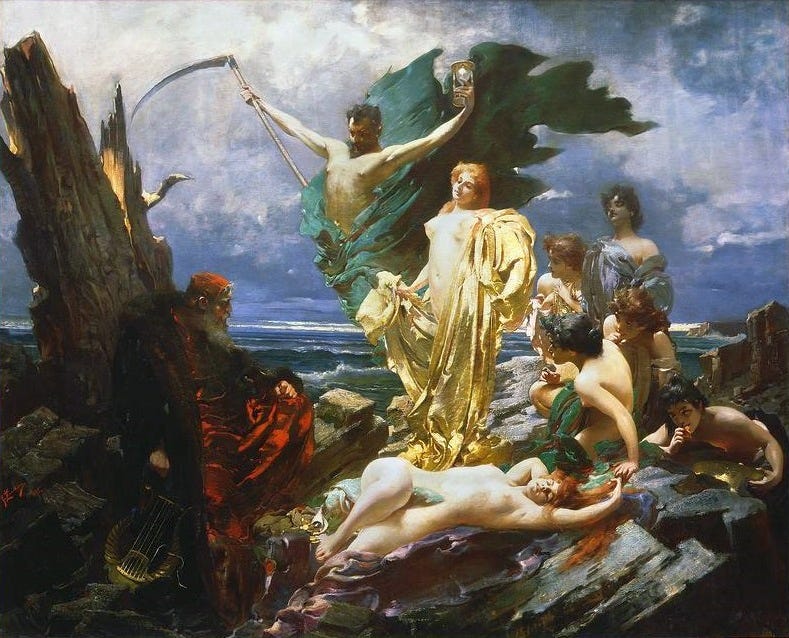
The Sinner’s Past - Seven Deadly Sins (1895) Franciszek Żmurko
There are seven of them. Seven quiet poisons. Seven well-dressed lies.
Lust.
We live in a time where bodies are collected like trophies and desire is confused for depth. We’re taught to crave endlessly, people, possessions, lifestyles that aren’t ours. We scroll, compare, consume, and call it aspiration. And when that hunger grows teeth, we rename it motivation to feel better about it. But lust doesn’t just live in the flesh; it lives in the wanting of what isn’t yours and the quiet dissatisfaction with what is. It hollows you out from the inside while making you look impressive on the outside.
Gluttony.
Somewhere along the way, fullness stopped meaning enough. Consumption became identity. Plates grew larger, screens grew brighter, opinions grew louder, but satisfaction never arrived. We don’t just overeat food; we gorge on information, validation, outrage, and entertainment. Always one more episode, one more scroll, one more purchase away from feeling whole. The hunger is never physical, and yet we keep feeding it, afraid of the silence that might appear if we ever stopped.
Pride.
There’s a quiet epidemic of inflated selves walking into rooms already convinced they’ve outgrown them. Humility is mistaken for weakness, listening for submission. Being seen has replaced being useful, and being loud has replaced being right. Pride doesn’t announce itself as arrogance; it disguises itself as self-respect. And in doing so, it seals people off from growth, because nothing new can enter a mind that believes it has already arrived.
Greed.
Progress was meant to move us forward, not hollow us out. Yet the appetite for more has no endpoint. Security keeps shifting its definition, success keeps moving the goalpost, and the rest is postponed indefinitely. Enough is never enough when the metric is comparison. Greed convinces us that peace is just one acquisition away, all while ensuring we never stop chasing long enough to find it.
Sloth.
Comfort has become a clever prison. Days blur into routines that demand nothing and promise even less. Potential is delayed under the assumption that time is abundant and urgency is optional. Stagnation no longer looks like failure; it looks like entertainment, like distraction, like harmless rest that quietly turns into years. Sloth doesn’t ruin lives dramatically; it lets them decay politely.
Envy.
Comparison now lives in our pockets, whispering constantly. Someone else’s highlight reel becomes the ruler by which we measure our worth. Gratitude erodes slowly as admiration turns into resentment. Envy doesn’t want what others have; it wants proof that you are lacking. And the more you stare at their plate, the colder your own meal becomes.
Wrath.
Anger has been given a microphone and told it is a virtue. Reaction travels faster than reflection, hatred faster than understanding. Pain is worn like Armor, and outrage becomes identity. Wrath tangles everything it touches, relationships, movements, intentions, until action is no longer about justice, but release. And in trying to burn the world down, we forget how easily we set ourselves on fire.
And so, my aspiration to be better this year is simple, brutal, and intentional: to stay as far away from these as possible. To resist what the world celebrates loudly and instead choose restraint, humility, patience, movement, gratitude, and calm. Not to escape desire, but to master it. Not to reject ambition, but to purify it. To live in a way that doesn’t just look good, but feels right when no one is watching.
Because maybe becoming better isn’t about becoming more.
Maybe it’s about becoming less of what’s slowly killing us, and more of what allows us to love, celebrate, and uplift without losing ourselves in the process.
Deus Vult
Jacob John
Over and out.
Music Recommendation
If you’ve been enjoying JAMM, you know the drill:
Subscribe to our growing tribe on Substack and share this with someone who needs to hear it.
Great reflections brother. It’s amazing how ancient wisdom still hits so hard, maybe even more so now, in a world that’s completely different from when it was first written.
The essay is so elegant and calm, which is such a trip compared to the chaos you’re actually describing. Honestly, I found myself looking for one 'crack' in the surface—a moment where a specific mistake really cost you something personal.